Science
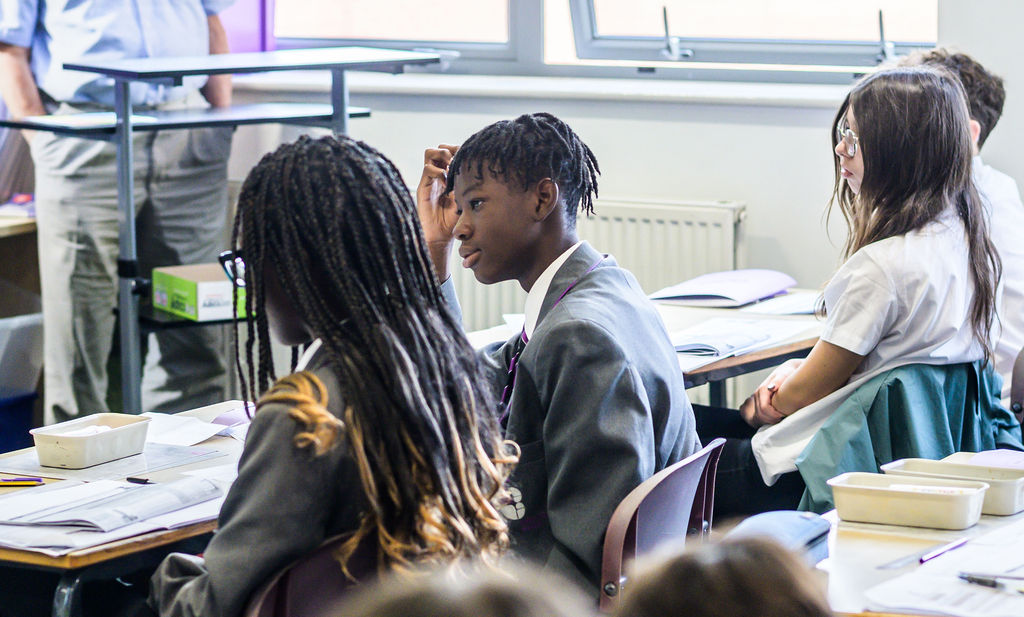
At Abbeyfield school we have an ambitious curriculum for all our students. Science encompasses everything that we are and allows us to make sense of the world around us. The students’ high-quality science education will develop students’ curiosity and scientific knowledge to question the world in which we live, enable critical thinking, and encourage students to become socially aware global citizens. As students’ progress through their scientific education, they should be able apply their scientific thinking and vocabulary to explain a wide range of phenomena, develop their experimental skills through a variety of scientific investigations and use their observations to justify the conclusions they have made, whilst using their analytical and evaluative skills to critically analyse information they are presented with.
Key stage 3
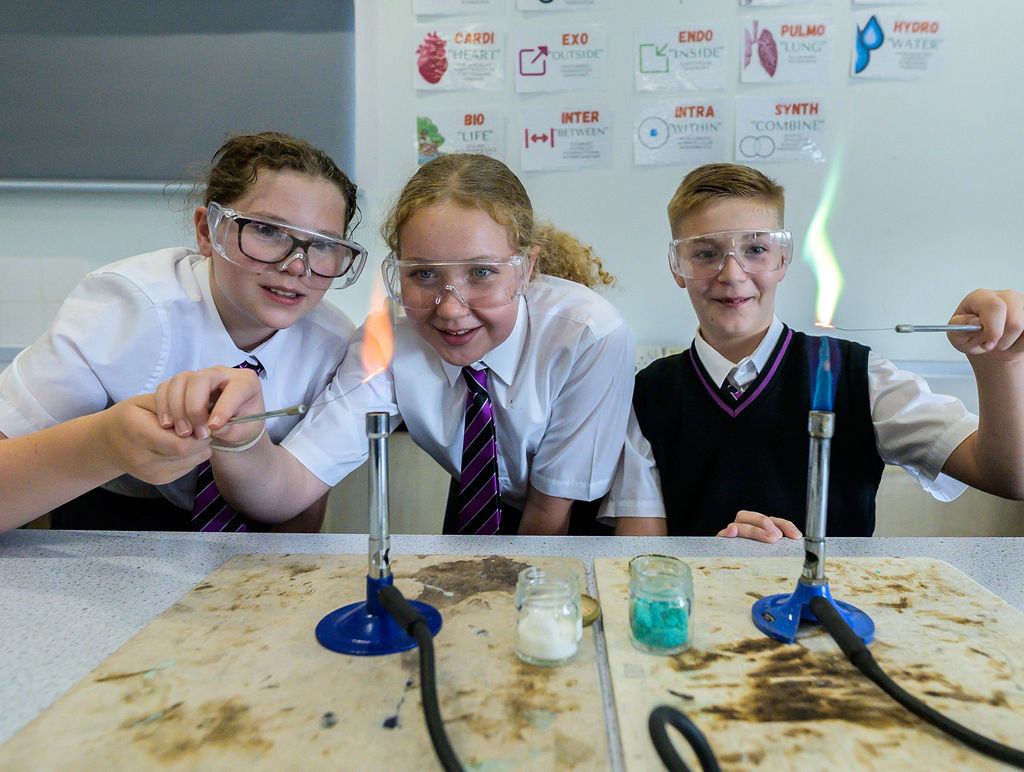
All students study all sciences at Key Stage 3.
In Year 7 students will:
Biology: Year 7 begins with ecosystems, developing students’ understanding of how organisms interact and depend on one another. This is followed by cells and organisation, building from the basic unit of life to tissues, organs and organ systems. Students then apply this knowledge to digestion and gas exchange, developing their understanding of how the human body obtains the substances it needs.
Chemistry: Year 7 begins with the foundations of chemistry, developing students’ understanding of the particle model and different types of chemical reactions. This is then applied to the Earth and rock cycle, exploring how rocks are formed and changed. Students finish with the periodic table, developing their understanding of elements and how they are organised.
Physics: Year 7 begins with an introduction to forces, building on students’ understanding of pushes and pulls from KS2. This is developed through sound and light, introducing waves as a way of transferring energy. Students then develop their understanding of energy stores and transfers and apply these ideas to everyday situations.
In Year 8 students will:
Biology: Students begin Year 8 with variation, evolution and genetics, developing their understanding of how characteristics are inherited and how populations change over time. This leads into reproduction and the passing of genetic information between generations. Students then explore photosynthesis and respiration, developing their understanding of how organisms obtain and use energy.
Chemistry: Year 8 begins with separating mixtures, building on students’ understanding of particles and substances from Year 7. Students then develop their understanding of climate and resources, applying their knowledge of the atmosphere and Earth’s resources. This is followed by metals and non-metals, acids and alkalis, allowing students to compare materials and explore their reactions.
Physics: Students begin Year 8 by developing their understanding of forces through forces and motion. This is followed by space, where students apply their understanding of forces, energy and light to objects beyond Earth. Students then develop their understanding of electricity and magnetism, including electrical circuits and magnetic fields.
In Year 9 students will:
Biology: In Year 9 students revisit their understanding on cells, developing it further after deepening their understanding of ideas around diffusion (beyond gas exchange in the lungs) and active transport. Information on cells is developed through understanding light and electron microscopes, and well as understanding exchange at boundaries Ideas around cells are developed further as it is discussed how they come together to protect the body from diseases. Links are then further made to health and disease, including how infections are spread as well as a maintaining a healthy diet. Students will develop their understanding of ecosystems by studying cycles of resources on our planet.
Chemistry: Students deepen their knowledge of the particle model, building on this by introducing the core concepts of an atom which they can then apply to the periodic table. Students begin to understand how atoms react and describe trends seen on the periodic table, before looking at how energy is involved in chemical reactions.
Physics: Students ‘knowledge of energy and work done is then linked to ideas such as the conservation of energy and discussing kinetic energy stores. This then links to the generation of electricity and natural energy resources.
Key stage 4 / GCSE
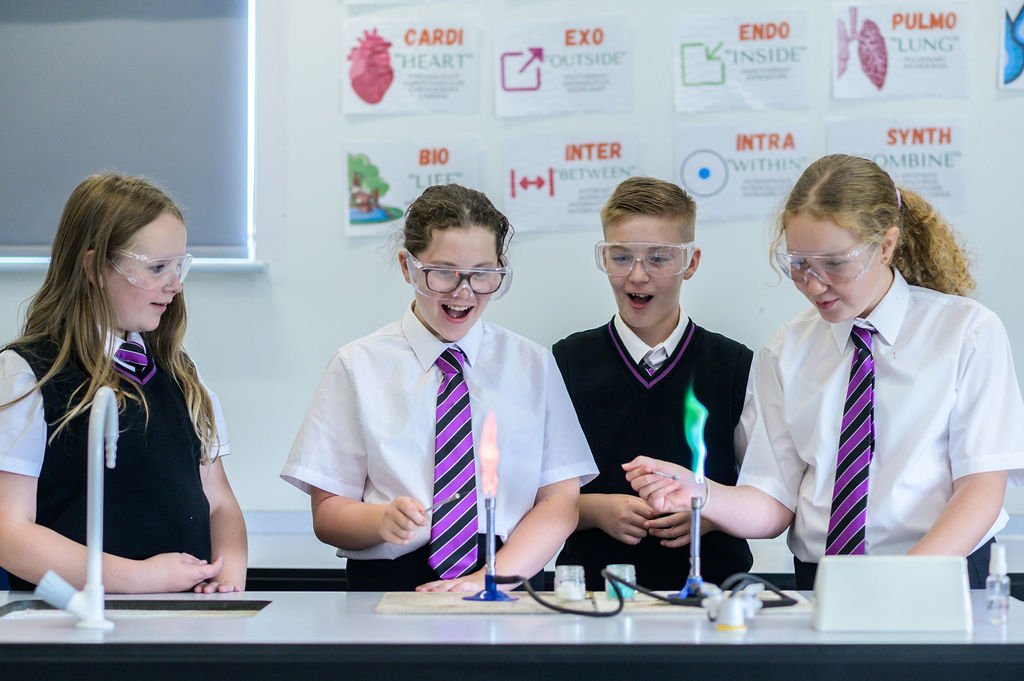
All students will need to take Combined science (sometimes known as double science). Some students may make triple science.
For combined science students will get a double grade e.g., 66, 76, 77 etc. which is an average of their biology, chemistry and physics marks.
For triple science, students will get three separate grades for biology, chemistry, and physics. Their grade in one science subject has no bearing on the grades of the other.
The exam board at GCSE is AQA.
In year 10:
Biology: Knowledge on cells and digestion is developed further by teaching organ systems such as the digestive system and circulatory system. Students are introduced to enzymes, and the optimal conditions needed for them to function. This leads to a discussion of the transport system in plants, and the optimal conditions required for that to occur. Breathing is discussed, developing on students understanding of respiration from previous years, as well as gas exchange from earlier in the year. This leads to students deepening their understanding of respiration. This leads to pupils linking this information together in the topics of respiration and photosynthesis.
Chemistry: Students develop the structure of the atom by studying bonding and linking this to the different properties of substances. Students use their understanding of Ion in electrolysis where students learn how electricity can be used to break down ionic compounds. They study how ions move to electrodes, what happens at the anode and cathode, and how electrolysis is used to extract metals and produce useful substances. In quantitative chemistry, students learn how to measure and calculate amounts of substances in chemical reactions. They study relative formula mass, moles, concentration, percentage yield and atom economy, and use calculations to understand chemical reactions.
Physics: In Year 10 Physics, students develop their understanding of the fundamental principles that explain how the world around us works. Through a combination of theory, practical investigations and problem-solving, students explore a range of important topics.
Students study Electricity, learning about circuits, current, potential difference and resistance, and how electrical energy is used in everyday life. In Atomic Model, they explore the structure of atoms, radiation and how our understanding of the atom has developed over time.
The Molecules and Matter topic focuses on the particle model, states of matter and how particles behave under different conditions. Finally, students investigate Waves, exploring their properties, how they transfer energy and their applications in the world around us.
In Year 11
In Biology, students study Homeostasis, exploring how the body maintains stable internal conditions, as well as Genetics and Evolution, investigating inheritance, variation and how species change over time.
In Chemistry, students explore Rates of Reaction, investigating the factors that affect how quickly chemical reactions occur. They also study Organic Chemistry, focusing on carbon-based compounds and their reactions, alongside Chemical Analysis, learning how scientists identify and analyse substances.
In Physics, students study Forces, exploring how forces affect the motion and behaviour of objects, and Magnetism, investigating magnetic fields, electromagnets and their applications.
Throughout Year 11, students continue to develop their scientific knowledge, practical skills and ability to apply their understanding to unfamiliar problems and real-world situations
Key Stage 5 / A-level and BTEC
The exam board for A-levels is OCR. For BTEC, the exam board is Edexcel.
Biology:
Biology A-level enable students to develop essential knowledge and understanding of different areas of the subject and how they relate to one another. They also gain an appreciation of scientific methods, as well as practical, mathematical, and problem-solving skills.
Students will study six modules:
Module 1: Development of practical skills in biology
Module 2: Foundations in biology
Module 3: Exchange and transport
Module 4: Biodiversity, evolution and disease
Module 5: Communication, homeostasis and energy
Module 6: Genetics, evolution and ecosystems
ASSESSMENT
There are four components that students must complete:
-
Biological processes (01) – 2-hour 15-minute paper modules 1, 2, 3 and 5
-
Biological diversity (02) – 2-hour 15-minute paper modules 1, 2, 4 and 6
-
Unified biology (03) – 1 hour 30-minute paper all modules
-
Practical endorsement in biology (04) – a non-exam assessment
Chemistry:
The content is in six modules:
Module 1 – Development of practical skills in chemistry
Module 2 – Foundations in chemistry
Module 3 – Periodic table and energy
Module 4 – Core organic chemistry
Module 5 – Physical chemistry and transition elements
Module 6 – Organic chemistry and analysis
ASSESSMENT
There are four components that students must complete:
-
Periodic table, elements and physical chemistry (01) –2-hour 15-minute paper modules 1, 2, 3 and 5
-
Synthesis and analytical techniques (02) – 2-hour 15-minute paper modules 1, 2, 4 and 6
-
Unified chemistry (03) – 1 hour 30-minute paper all modules
-
Practical endorsement in chemistry (04) – a non-exam assessment
Physics
The content is in six modules:
Module 1: Development of practical skills
Module 2: Foundations of physics
Module 3: Forces and motion
Module 4: Electrons, waves, and photons
Module 5: Newtonian world and astrophysics
Module 6: Particles and medical physics
There are four components that students must complete:
• Modelling physics (01) – 2-hour 15 minute paper modules 1,2, 3 and 5
• Exploring physics (02) – 2-hour 15-minute paper modules 1, 2, 4 and 6
• Unified physics (03) – 1 hour 30-minute paper all modules
• Practical endorsement in physics (04) – a non-exam assessment